Sewn vs Welded Filter Bags: Which Is Better for Your Application?
Choosing the right filter bag construction is a critical decision in industrial filtration. Whether you are working in water treatment, food processing, or chemical production, the performance of your system depends heavily on the
seam design of your filter bags. Two common options dominate the market:
sewn filter bags and
welded filter bags.
In this article, we compare both types to help you determine which is best suited for your specific application.
Understanding Sewn Filter Bags
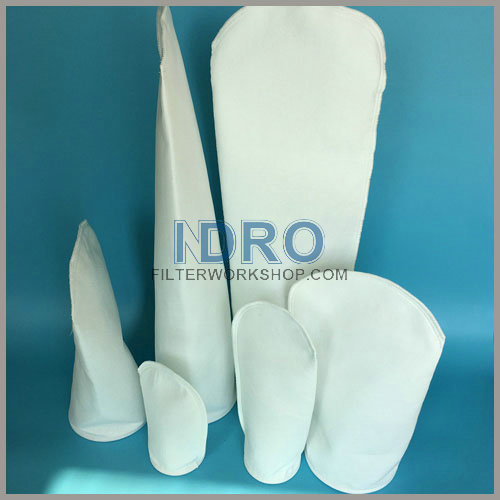
Sewn filter bags are manufactured using industrial sewing machines to stitch together filter media panels. This is the most traditional and widely used production method.
Key Advantages
- Cost-effective: Lower manufacturing cost makes them ideal for large-scale use
- Material flexibility: Compatible with a wide range of fabrics such as polyester, polypropylene, and nylon
- Strong mechanical seams: Reinforced stitching provides durability in high-flow conditions
Limitations
- Potential leakage: Needle holes may allow fine particles to pass through
- Not ideal for fine filtration: Especially for micron ratings below 5 µm
- Limited for sterile applications: Stitching can compromise purity requirements
Sewn filter bags are commonly used in applications where
cost and durability are more important than absolute filtration precision.
Understanding Welded Filter Bags
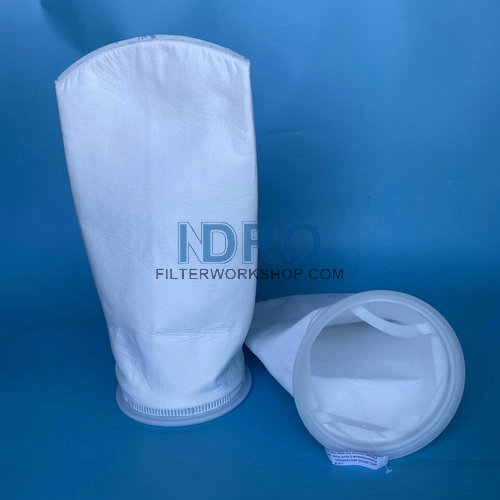
Welded filter bags are produced using thermal or ultrasonic welding technology, which bonds the material without puncturing it.
Key Advantages
- Leak-free seams: No needle holes, ensuring higher filtration efficiency
- Ideal for fine filtration: Suitable for low micron ratings and critical processes
- Cleaner construction: No thread contamination, making them perfect for hygienic industries
- Consistent quality: Automated welding ensures repeatability
Limitations
- Higher cost: More advanced manufacturing process
- Material limitations: Not all fabrics are suitable for welding
- Less flexible in design: Compared to sewn options
Welded filter bags are widely used in industries requiring
high purity and precision, such as pharmaceuticals and food & beverage processing.
Key Differences at a Glance
| Feature |
Sewn Filter Bags |
Welded Filter Bags |
| Seam Type |
Stitching |
Heat/ultrasonic welding |
| Leakage Risk |
Moderate |
Very low |
| Filtration Precision |
Medium |
High |
| Cost |
Lower |
Higher |
| Suitable for Sterile Use |
No |
Yes |
| Material Compatibility |
Wide |
Limited |
Which One Should You Choose?
The choice between sewn and welded filter bags depends on your application requirements:
Choose Sewn Filter Bags if:
- You need a cost-effective solution
- Your filtration process handles larger particles
- Minor leakage is acceptable
- You require robust mechanical strength
Choose Welded Filter Bags if:
- You need high filtration accuracy
- Your process demands zero leakage
- You operate in food, beverage, or pharmaceutical industries
- Cleanliness and contamination control are critical
INDRO’s Approach to Filter Bag Manufacturing
INDRO Filter Workshop provides both sewn and welded filter bag solutions, tailored to different industrial needs. By combining advanced sewing technology with modern thermal welding systems, INDRO ensures:
- Consistent product quality
- Customizable designs for various applications
- Reliable performance in demanding environments
Their manufacturing expertise allows customers to select the most suitable filter bag type without compromising on efficiency or durability.
Conclusion
There is no one-size-fits-all answer when it comes to sewn vs welded filter bags. Each type has its own strengths and ideal use cases. Sewn bags offer affordability and versatility, while welded bags deliver superior sealing and filtration precision.
Understanding your process requirements—such as particle size, cleanliness standards, and budget—will guide you to the right choice. With the right filter bag design, you can significantly improve system efficiency, product quality, and operational reliability.